Saturday, October 29, 2011

Egypt: Part II.

Egyptian sunrise, as seen through train window.
The train ride to Aswan was about 12 hours long, and we arrived in the city at about 11:30 in the morning. The first thing I noticed as we stepped off the train was the heat. It was oppressive, to say the least. Though it would prove to pale in comparison to Hatshepsut’s Tomb in Luxor.

Located in southern Egypt, at the first cataract of the Nile, Aswan was formerly a border town of the ancient Egyptian empire. It now exists as a major tourist attraction, with some great museums and Egyptian ruins. Unfortunately we only had about a day to spend in the city before we headed to Luxor, and we weren’t able to see the museums, or much of the ruins. What we did do, though, was take a felucca ride on the Nile to Elephantine Island, where we explored a couple of Nubian villages, and had tea at one of the homes.

Countryside.

I couldn't really sleep on the train ride, so I took pictures instead.

Welcome to Aswan!

Crossing the Nile.

Aswan from the river.

Shoreline.


Nubian village.

Some of the locals.

Trying to find the house we were going to have tea at. We literally followed these signs around for twenty minutes.

At the "Baba Dool" Nubian house.

Nubian crafts.

A village boy showing us some of the wall decorations.

The entire house was very colorful.

Looking out from the roof of the house.

The Nile.

Sunset on the Nile.

Aswan at night.

Our accommodations, the old Horus Hotel.

Aswan markets.

The Souk.

Spices.

The next day (Sunday), we took a taxi to Luxor, which I would say was the highlight of the trip. We stayed in the esteemed Al-Salam hostel, which, though scarily cheap, was actually one of the better hostels of the trip. After dropping our bags in our room, we went to dinner at a restaurant in the main square of Luxor; right outside the Luxor Temple ruins, which we would visit later that night. I decided to order a traditional Egyptian dish: pigeon, which was actually really good. It tasted like dark turkey meat.
On the road to Luxor.

Truck full of camels. We drove behind this for about forty minutes, and it provided endless entertainment.

Locals. In the top left, you can see a part of my finger as I attempt to disguise the fact that I was taking a picture of these girls. It didn't work.

The first in my new series: 'Translation mistakes in Egypt'.

Another translation gem.

Our room at Al-Salam. We had air-conditioning, but it cost extra to use, so we opted out.

Luxor train station.

The bustling train station interior.

Another installment of 'Translation mistakes in Egypt'.
Restaurant we ate at.

Pigeon.


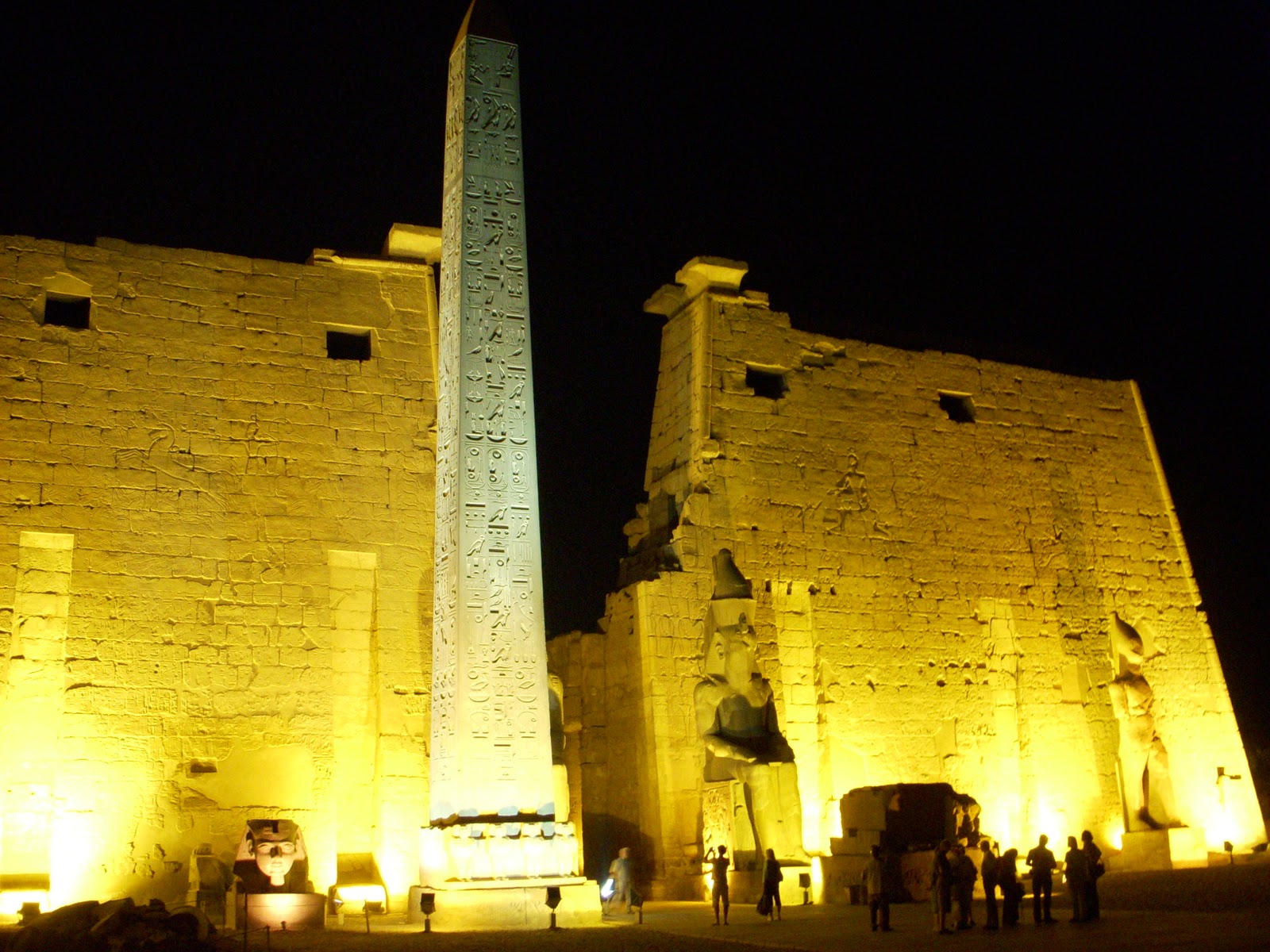
After dinner, we explored the beautiful Luxor Temple, which was stunning, especially lit up. If you don’t believe me, check out these pictures:

Entrance to the temple complex.

Sphinx.

The lighting was amazing.

Statue. It looks more Roman or Greek than Egyptian.


Probably a pharaoh or something.

The columns were stunning.

Profile.

I still can't believe how clear these hieroglyphics are.

The columns, especially when they were lit up, were visually overwhelming.

Very cool.

Moving deeper into the temple.

Some of the walls were still painted.

The level of detail in the hieroglyphics was extraordinary.

The weird symbol by the hawk's beak is apparently an Egyptian symbol called 'ankh', which represents eternal life.

Avenue of the Sphinxes. This used to go from the Luxor Temple all the way down to the Karnak Temple, which is a couple of miles away.
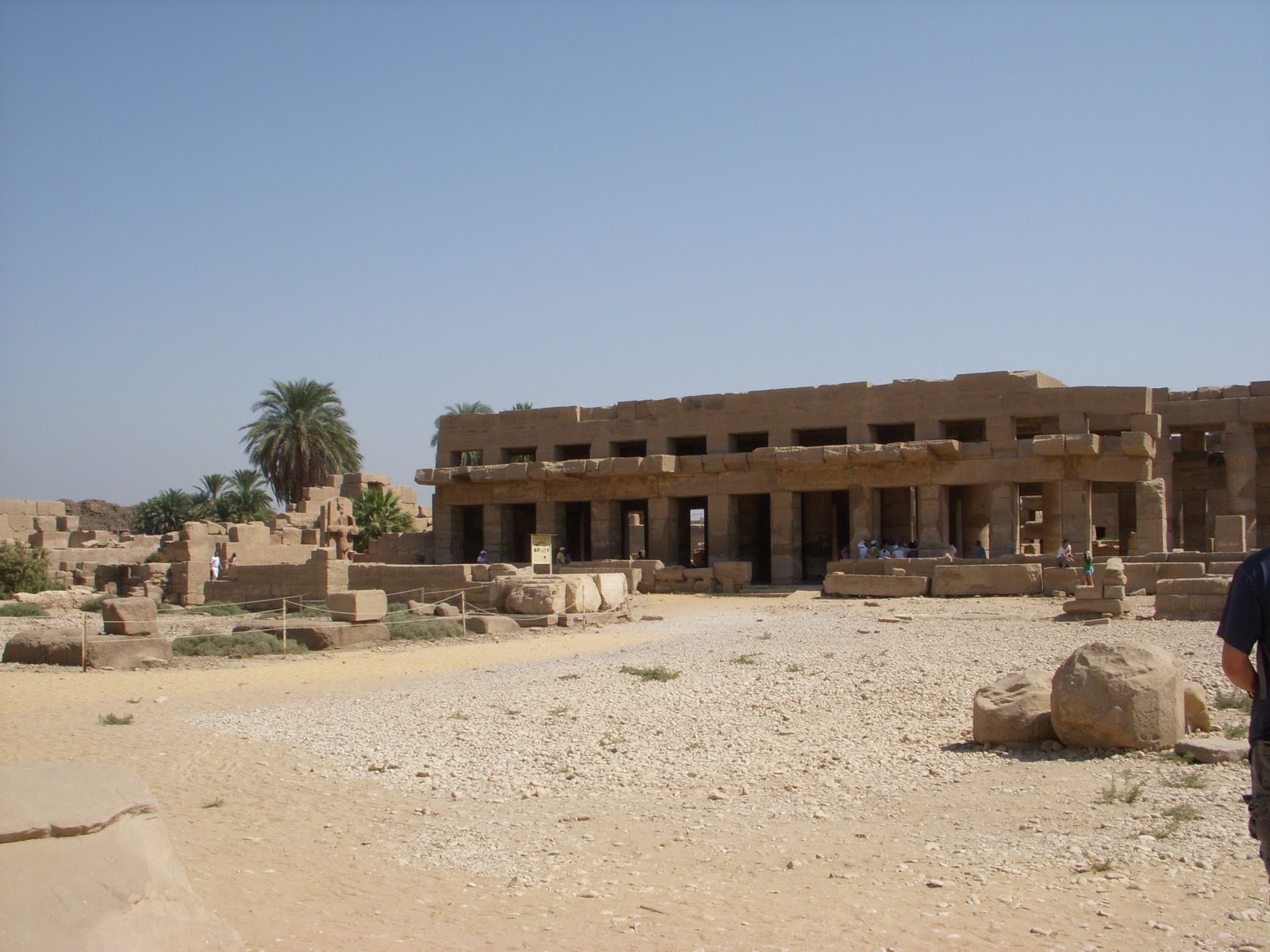
 Monday was devoted to the Karnak Temple, a massive, sprawling place, and one of the largest religious complexes on earth. Instead of taking a cab there, we questionably decided to bike. Though Luxor is no Cairo (where we were given the following instructions on how to cross the perpetually crowded streets: close your eyes, pray to Allah, and go), the streets are still full of Egyptian drivers, meaning that they’re perilous places. Consequently our fifteen minute bike ride was filled with near misses, blaring horns, and I was constantly afraid for my life. But once we arrived at the temple, it all proved to be worth it.

View from our room.

Model of what the Karnak Temple used to look like.
Walking toward the temple entrance.


Here's another part of the Avenue of Sphinxes.
Ariel map.

Statues.

More statues.

There weren't too many tourists here either, which was great for us.

Hieroglyphics and carvings.

Huge statue.


The pillars here were enormous. It must have been magnificent to see when it was first built. This was in a part of the temple known as the Great Hypostyle Hall.
Some of the undersides of the stones connecting the pillars still had paint on them.
Close-up of a pillar.

Hieroglyphics.


This was called the Sacred Lake. It's seen cleaner days.
 The pharaohs of ancient Egypt used to add on to the Karnak Temple during their reigns; with each pharaoh trying to build more impressively than the last. The temple is divided into four precincts, though only one of them, the precinct of Amun-Re, is open to the public. This turned out to be a good thing, however, because it took us several hours just to see all of that precinct, and by the time we finally finished, we were utterly exhausted.


Obelisk.

There wasn't a single cloud in the sky that day.


A shaded part of the ruins, where we took a break from the sun.


Looking out on the ruins. Note how small those people in the center are compared to everything around them.


This was a cool shade of blue.

I don't know why only the blue paint remained.

More carvings. The figures to the left and right of the center figure are both Egyptian gods. The one on the left is Thoth (I think), the ibis-headed god of wisdom and the moon. The one on the right is Horus, the falcon-headed god of the king, sky, and vengeance.

This was a scarab statue that we saw people running circles around, for some reason. Still have no idea why.

After biking back to the hotel, we devoted an hour to showering and napping, before heading to the hotel lobby (a generous label), where we decided to take an afternoon felucca ride on the Nile.
Docked cruise ships. Because of the lack of tourists, we saw a lot of these.

Feluccas.

I loved watching these.

These guys definitely saw me take a picture of them.

The Nile.

Ibis. I think.

Cow.

Another Nile view.

View of an island on the river.
A man praying on the river bank.

View from our boat.

I like this one.

Banana Island.

Our felucca ride was the perfect way to spend an Egyptian afternoon. We leisurely made our way down the river, enjoying the scenic views and peaceful atmosphere, before docking at the aptly named Banana Island. Our felucca captain took us on a quick tour of the island, which ended with fresh, local bananas, as well as tea flavored with lemons picked from a nearby tree.
The local fruit.

Exploring the island.

Donkey.

Some locals.

It was a beautiful island.

Had to include this picture.

Our felucca captain explaining the local flora.

Tea and bananas, pre-consumption.

Post-consumption. Delicious.

Heading back to the felucca.

Sunset.

The Nile at dusk.

After sailing back to the east bank, we spent some time wandering around the local Souk, where we became painfully aware of the lack of tourists as we were constantly mauled by shopkeepers.

Some graffiti we saw.

The Souk.

Chickens in crates.

The next day was devoted to the monuments on the west bank of the city: the Valley of the Kings, Hatshepsut’s Temple, and the Rasmesseum. There were more, the Valley of the Queens among others, but we didn’t want to cram too much into one day. Also we were in one of the hottest places on earth, and by about two in the afternoon I had sweated out half my body weight and wanted nothing more than a cold shower.

We woke up at 7am, thinking that if we could make it to the west bank relatively early, we might beat the heat. How naïve we were. It was sweltering by the time we made it to the Valley of the Kings (8:30), and it only got hotter as the day went on. But we had a great time nevertheless. The Valley of the Kings didn’t allow cameras into the site, though I managed to sneak mine in anyways. What can I say; I had a responsibility to my blog and my readers. Even though many of the tombs we wanted to see were closed for various reasons, we were still able to see some amazing things.

Walking to some tombs.

The Valley of the Kings.
The burial chamber of one of the Valley of the King tombs. Don't tell the Egyptian government I took this picture.

Tomb entrance.

Tomb decoration.

At the entrance of a tomb.

Cool hieroglyphics.

Inside of a tomb. That's the Egyptian god Horus on the right.

Tomb ceiling.
Descending into the tomb.
Another cool ceiling.


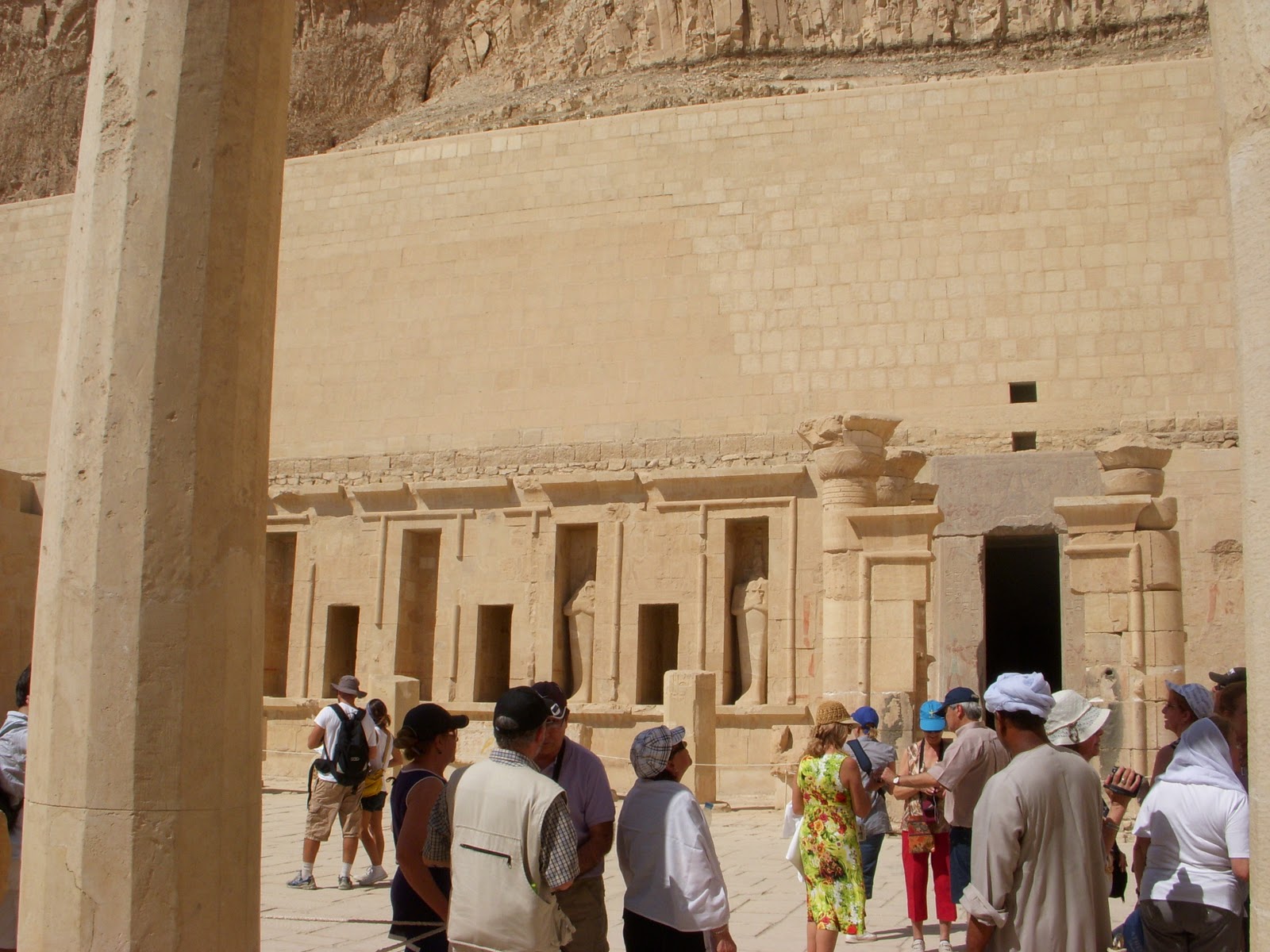
Our next stop was the Al-Deir Al-Bahari Temple, or the Temple of Hatshepsut, only a short drive from the Valley of the Kings. We spent about an hour here, admiring the massive structure, before heading to our final stop in the west bank.
The temple from a distance. If it looks like we're in a desert, it's because we are. And it definitely felt like one.

I think calling this a tree is a bit generous.

Temple of Hatshepsut.

Side view.

Looking out from the temple.

Temple interior.

Paintings.

Hieroglyphics and such.

Statues in Hatshepsut's likeness (I think).

Inside the temple.

Columns and shadows.

There's literally a line between lush, Nile-fed green land, and utter desert.

Another temple picture.

A temple commissioned by the Pharaoh Ramses II, the Rasmesseum is home to a massive collapsed statue of the ruler, which inspired the poem “Ozymandias” by the English poet Percy Shelley. After spending an hour here, we returned to our hotel, and spent the rest of the day exploring Luxor, including returning to the Souk.
Cool sphinx at the entrance to the temple. Though I didn't get another picture of it, so apparently I didn't think it was that cool.


Rasmesseum.

The fallen statue of Ramses II.

Feet.
Hands.


Ramses II.


Graffiti from the 1800s. Kind of cool.


More graffiti.

Cool carvings.


See if you can spot the modern addition.

Egyptian pigeons. Similar to the one I consumed.

Luxor sunset.
Souk.

The first class staff at Al-Salam! I'm nearly positive that the man to the left lived in our lobby, as we saw him go to sleep each night on the couch that I'm sitting on.

Waiting for our train to Cairo.


At 11pm, we boarded a train for Cairo, and began the final leg of our Egyptian journey.

Monday, October 24, 2011

Egypt: Part I.

On October 12, the Jewish holiday of Sukkot began, which meant that we had a week and a half long break from class. During this break, I decided to go with three friends, Jacob, Ellen, and Sara, on a trip to Egypt. We planned to visit Cairo first, and then take a train down the Nile to Aswan. After spending a day or so in Aswan, we planned to head up to Luxor, seeing the Egyptian tombs there, before taking a train back up to Cairo, where we would finish up our trip. Considering the time we had, about ten days, and the amount that we planned to do, it was a fairly ambitious plan, but it all worked out in the end. We had an amazing time. I took over 750 pictures too, which is part of the reason why I’m splitting up the trip into three separate posts: one for Cairo at the start of the trip, one for Aswan and Luxor, and one for Cairo at the end of the trip.

In order to be able to enter Egypt, I had to first get an Egyptian visa- a step my friends had already done. This meant that I had to take a bus to Eilat on Tuesday night, so I could get the visa Wednesday morning, and then leave with my friends once they arrived from Jerusalem. It turns out that the buses leaving from Jerusalem were full, so my friends had to go to Tel Aviv to find a bus, which delayed them for several hours. It also meant that we missed the bus we planned to take to Cairo, and when we crossed into Egypt, we had to take a minibus/taxi thing instead.

The beach at Eilat. Not a bad place to wait around for a couple hours.


From our minibus driver, we learned that we had to pay a border fee before we could start our journey, and that we could only pay the fee in Egyptian pounds. Predictably, the ATM at the border station was broken, so we were forced to buy Egyptian pounds from our driver instead. This led to a fierce battle over a fair exchange rate which lasted around twenty minutes, and during which I began to doubt we would ever make it to Cairo. Finally, we agreed on a rate (5 pounds per dollar), after which our driver, who until this point had acted very irate, broke into a broad smile, extended his hand, and, while chuckling, said: “Welcome to Egypt.”

That car ride through the Sinai on Wednesday night was the only time in the entire trip that I felt unsafe. Not because I expected terrorists to jump out of nowhere and kidnap us, but because our driver seemed to be under the impression that he was invincible, and therefore didn’t need to pay any attention to local traffic laws. I spent hours gripping my seat as we sped towards massive semis and took tailgating to a whole new level. To make matters worse, I couldn’t sleep through the ride due to the odd, atonal, prayer-like Arabic music that was blaring on the radio. The entire time I felt as though I was in some sort of weird, surreal nightmare. But, against all odds, we managed to arrive safely in Cairo.

Sinai truck stop.


The next morning, we awoke and went to the train station to purchase our tickets to Aswan, then headed to downtown to the Egyptian Museum. The Museum was incredible, and we spent hours admiring the countless artifacts on display. We also saw a special exhibit devoted solely to mummies, which was amazing. There’s really nothing quite like staring into the face of a three thousand year old man. Unfortunately we had to leave our cameras at the door, so I don’t have any pictures to share.  After the museum, we went to dinner, wandered around Cairo for a bit, and then went to bed.

Friday was devoted to the Pyramids. We went back to the Egyptian Museum, and waited for a bus that supposedly left from just behind the museum, and would take us straight to the Pyramids. We ended up boarding the wrong bus, which let us off somewhere in Giza (just outside Cairo), and wandered around for a bit, hopelessly lost, until we came across a man who lived right next to the monuments. He invited us over for tea (Egyptian tea, by the way, is incredible), and we took a taxi to his village. He even insisted on paying the taxi fare, which was nice.

Our new friend (forgot his name) wasn’t joking, we could see the pyramids from his living room window, and got an even better view from the roof of his apartment building. He explained that his entire family lived in this building (aunts, uncles, etc) which is apparently quite common in Egypt. After tea, he took us to a business owned by a friend of his, where we were able to rent camels to take to the pyramids. We were also able to cheaply rent a taxi to take us to Saqqara and Dahshur (where there are even more pyramids) after we finished our camel tour.

It was a little hazy that day, but this is the view from our friend's living room. You can just make out the outline of a pyramid in the distance.


Riding a camel was an interesting experience. There was a lot of leaning and swaying involved, and my camel (mysteriously named ‘Michael Jackson’) wasn’t the most pleasant of creatures. The pyramids were awesome though. I’ll let my pictures speak for themselves, but it was amazing to see the last existing wonders of the ancient world. The Sphinx was pretty cool too.

My faithful steed, Michael Jackson.

Camel cam.

Jacob and Ellen, on Secret of the Desert and Mickey Mouse.

Pyramids.

They were huge.

More pyramids.

Michael Jackson. Also, my new facebook profile picture.

Our camels, enjoying the Egyptian sun.

Looking up from the base.

Looking back towards Giza and Cairo. The city was much closer to the pyramids than I expected.

Another pyramid shot.

Sphinx

Luckily, there weren't many tourists around.

I could have looked at these all day.

After our tour of the Giza pyramids, we hopped in our taxi and drove to Saqqara, home to the first Egyptian pyramid ever built. We spent about an hour there, and then drove a bit further to Dahshur, home to what is known as the Red Pyramid and the Bent Pyramid. We were able to go inside the Red Pyramid, which was an amazing (if overly hot) experience. After we reemerged from the Red Pyramid, we took a break before heading back down to our taxi (the entrance to the pyramid was about halfway up the structure itself), and started talking with a group of people who were about to follow in our footsteps. It turns out they were studying at the American University in Cairo, and they knew Charlotte Berschback, a high school classmate of mine who was studying there as well. Small world, I guess.

There was a small museum at Saqqara as well. This was inside, a small sphinx of the pharaoh who ordered the building of the stepped pyramid.

The Stepped Pyramid at Saqqara.

The ruins of a temple complex near the pyramid.

Stepped Pyramid.

The Bent and Red Pyramids as seen from Saqqara.

Ruins at Saqqara, with the Giza pyramids in the distance.

The Red Pyramid. About a third of the way up is the entrance to the structure itself.

View from the Red Pyramid.

Another shot from the Red Pyramid.

Descending.

One of the chambers inside of the pyramid. There were three of these.

Passage connecting the chambers.

We had to climb these to reach the final chamber, which once served as a pharaoh's tomb.

Tomb chamber. Very cool. Also very hot and very humid.

Ascending.

Bent Pyramid. And camel.

New and Old.

Mosque.

The red building is the Egyptian Museum in Cairo. There was also a burned out building on the left, which I would guess is a casualty of the revolution.


After experiencing the pyramids, we returned to Cairo. We had a couple of hours to kill before our train left, so we grabbed some food, and then decided to head to Tahrir Square, to see the epicenter of the Egyptian revolution. Turns out there was a protest going on, and after spending some time observing from a distance (don’t read this part, Mom) we decided to have a closer look and see what the protest was all about. We wandered around the square, talking to people and looking at the flags and posters they were carrying. From what I understood (which wasn’t very much), they were protesting something the police had done during an earlier demonstration put on by the Copts. But I could be wrong. Either way, it was a once in a lifetime experience.

Tahrir Square protest.

Wandering around the square.

This made me really wish I could read Arabic.

These were on display in the square, though I have no idea what they mean.

This one was really cool.

Don't know who these people are.

A huge mosque in Cairo.

Here's a video that I took of the protest! It took forever to upload, so I hope it works. At one point I pan over to some locals who we asked about the protests. So if you suddenly see a close up of some random Egyptians, that's why.

Well, that’s it for Part I of my Egypt trip. Stay tuned for Part II, where I’ll talk about Aswan and Luxor!

Friday, October 7, 2011

One Month.

I’ve been in Israel for 32 days now, and they have been some of the best of my life. I’ve made new friends, seen new places, and learned new things, both inside and outside the classroom. A lot has happened, especially in the last two weeks, and its about time I started blogging about it all. So here it is:


I love my classes, even though we’re only one week in. Here’s my weekly schedule:

Sunday:

Emergence of the Modern Middle East 12:30-2:15

Perspectives on Islam 4:30-6:15

Monday:

Modern Hebrew 8:30-12:00

Foreign Policy of Israel 4:30-6:15

Tuesday:

Theories of International Relations and the Middle East 8:30-12:00

Emergence of the Modern Middle East 12:30-2:15

Perspectives on Islam 4:30-6:15

Wednesday:

Modern Hebrew 8:30-10:00

Foreign Policy of Israel 4:30-6:15

Thursday:

Modern Hebrew 8:30-10:00


If you’ll notice, I have classes on Sunday, which has been kind of strange. Having class at 8:30 four days in a row is also a bit rough sometimes, but I’m slowly getting used to it. My classes are made up of all international students, and I think none of them are larger than about thirty students. The professors are all great so far, and it doesn’t look like they will be too much work (aside from reading). Finals week is going to be rough, but I prefer not to dwell on that right now.

In addition to my classes, I was also recently hired as an intern at an organization called the Institute for Monitoring Peace and Cultural Tolerance in School Education, or IMPACT-SE. Here’s their website:  http://www.impact-se.org/

Basically what they do is analyze school curricula of Middle Eastern countries, looking specifically at the cultural ‘other’ (i.e. the West for Iran). Their goal is to promote tolerance in Middle Eastern education, in the hopes that by changing the way different cultures view one another, it will be easier for them to peacefully coexist. They hired me both to do research, and to work on fundraising, so look for some shameless promotion in my coming blog posts!

On top of the internship and classes, I’ve also been asked to blog for Masa Israel, which is a group that helps students (specifically Jewish students) fund study abroad trips to Israel.  So about every two weeks or so, I’ll submit a blog post about my experiences to be posted on their website. Here are links to two posts I wrote about how I spent Rosh Hashanah here in Jerusalem:  http://tinyurl.com/6gcjhb6  http://tinyurl.com/6anqlxy


Finally, I want to end this post with somewhat of an announcement. I recently became aware of an intensive Arabic language program offered through Hebrew U in the spring. As I was planning to study the language anyways, I decided to explore the program, and see what it offered. It consists of 14 credits of Arabic classroom instruction, tutorials, workshops, and related field trips and activities, as well as a 3 credit course on Islam. Not only would this be the best introduction to Arabic that I could get, the program also makes financial sense as well. So after several weeks of weighing the pros and cons, I finally made my decision. As of this week, I’m officially staying in Israel for the year, meaning that I won’t be back until sometime in June. It’s a big decision, but I’m confident that I’ve chosen correctly.

I promise that my next post will have more pictures, so check back often!